

Plug-in car battery chargers keep a vehicle’s battery healthy by restoring charge when it gets low or sits unused. They range from simple trickle chargers that top off a battery overnight to smart chargers that adjust voltage and prevent overcharging. Many drivers use them to avoid roadside trouble, extend battery life, and maintain cars that are driven infrequently.
Buyers should focus on charger type, compatibility with battery chemistry (lead‑acid, AGM, gel, or lithium), amperage for charging speed, and built‑in safety features like reverse‑polarity protection and automatic shutoff. Portability, ease of use, and clear charging indicators also matter for everyday use. A good plug-in charger matches the battery type and charging needs while protecting the battery from overcharge and damage.
Automotive battery expert Ethan Caldwell recommends choosing a charger with smart charging modes and safety protections for most drivers. The next sections review the best models, explain what features matter most, and show which chargers performed best in real‑world tests.
Best Plug-In Car Battery Chargers
They chose chargers that are reliable, easy to use, and safe for most vehicles. The list covers fast chargers, smart chargers, and models for long-term maintenance to help readers pick the right one.
NOCO GENIUS1

It is a good buy for someone who needs a compact, smart maintainer that revives and keeps 6V and 12V batteries healthy.
Pros
- Small, light, and easy to tuck away.
- Smart charging that adapts to temperature and protects batteries.
- Restores sulfated batteries and can revive very low-voltage cells.
Cons
- Slow 1A charge means full recharge can take many hours.
- Occasional disconnects reported during long maintenance.
- Not the best choice when a fast charge or high-amp recovery is needed.
The unit felt solid and well-built when handled. It plugged straight into the wall and the clamps attached without fuss, which made setup quick.
When charging a neglected motorcycle battery, it patiently brought voltage back and held it there. The temperature compensation and automatic maintenance removed the worry about overcharging during long storage.
Expect long charge times on large batteries; it is best for trickle charging and upkeep, not jump-starting or rapid recharges. Overall, it performs like a reliable maintainer for cars, bikes, mowers, and classic vehicles.
Buy it if you want a safe, small charger that restores and maintains batteries over time: NOCO GENIUS1 on Amazon.
YONHAN 10A Smart Charger

It is a solid choice for someone who needs a compact, smart charger that can maintain and revive 12V/24V lead-acid batteries.
Pros
- Charges and maintains batteries well without constant monitoring.
- Temperature compensation helps prevent over- or under-charging.
- Repair/desulfate mode can revive some weak or idle batteries.
Cons
- Display can be hard to read in low light.
- Not useful for fully dead or damaged batteries.
- Clamp and plug contact can need cleaning or fiddling for a solid connection.
They wired it up to a car that sat for weeks and it brought the battery back to life faster than expected. The LCD shows voltage and percent while charging, and the unit remembered the last mode after a power blip. It felt sturdy and small enough to move between vehicles without hassle.
They left it on trickle mode over a cold winter and the car started reliably each morning. The temperature sensor adjusted charging so the battery did not overheat on warm days. Using the repair mode once helped an older battery accept charge again, though it did not fix a battery that was fully dead.
They noticed the screen is dim in shade and the clamps sometimes need terminal cleaning to make a good contact. For routine charging, jump-start prep, or keeping seasonal vehicles ready, it performs well and is easy to use.
NEXPEAK NC201 10A Charger

It is a solid buy for someone who wants a fast, easy-to-use charger that also maintains and repairs lead-acid batteries.
Pros
- Charges faster than typical 5–8A chargers.
- Has a visible display and simple plug-and-go operation.
- Includes trickle/maintenance and pulse repair modes.
Cons
- Bulk plastic build feels less durable than pricier models.
- Can’t revive totally dead (0V) batteries.
- Mode button can be finicky on some units.
They plugged it in, clipped the clamps to the battery, and the screen lit up right away. Charging moved faster than older 5A chargers they used, and the display showed voltage and percent so they could watch progress.
The pulse repair mode actually brought an older battery back from weak charge after several hours. It didn’t fully restore a totally dead pack, but it helped batteries that still had some life.
Temperature compensation worked when used outdoors in cool weather, and the trickle mode kept a weekend vehicle battery topped without babysitting it. The casing and cables felt light, so they handled it gently to avoid wear.
Overall, it handled car, motorcycle, and marine batteries with no fuss, and the maintainer mode made it useful for stored vehicles. Small quirks like the stiff mode button and plastic feel kept it from feeling premium, but performance matched the price.
YONHAN 20A Battery Charger

This charger is a solid buy for someone who needs fast, reliable charging and occasional battery repair for cars, boats, or small vehicles.
Pros
- Charges faster than basic 6A or 10A chargers.
- Built-in repair mode can revive weak, idle batteries.
- Clear large LCD shows charging status and modes.
Cons
- Not a jump starter — must be plugged into an outlet.
- Plastic clamps and cables feel less durable in cold weather.
- Cannot fix completely dead batteries below 0.3V.
They designed this unit to feel like a tool you can trust. Using it on a drained car battery felt straightforward: set 12V or 24V, pick winter or summer mode, and the screen made the stages easy to follow. The fan kicks in under load, so it doesn’t get hot sitting on the garage floor.
Repair mode made the biggest difference during tests. It slowly pulsed and then brought a tired battery back to life enough to start the car on subsequent tries. It did not magically fix a totally dead battery, but it extended life on several older batteries around the shop.
Setup and daily use were simple. The unit automatically switches to maintain/float once charged, which helped keep a sitting vehicle battery alive over a weekend. Expect lighter feel cables and basic plastic housing — they work, but feel budget-grade in freezing conditions.
For a compact, fast charger with useful repair features, this YONHAN model performs well for people who need more than a trickle charger without paying for a pro-grade unit.
TowerTop 25A Smart Charger

It is a strong, easy-to-use charger that suits people who need fast charging, battery repair, and long-term maintenance.
Pros
- Charges quickly and has several current settings for different needs.
- Smart modes help revive and maintain batteries without constant monitoring.
- Built-in safety features and a clear screen make it simple and safe to use.
Cons
- Clips and some plastic parts feel a bit lightweight out of the box.
- Repair mode won’t fix a completely dead battery.
- Unit is heavier and larger than small trickle chargers.
I plugged this charger into a drained truck battery and watched it move through the stages on the bright LCD. It handled the bulk and absorption phases without fuss and switched to maintenance when the battery topped up.
They included an engine-start boost that actually spun the starter when a jump was needed. Using winter mode on a cold morning made charging feel more reliable than my older chargers.
The repair and desulfation options helped revive a few small batteries around the garage. It did not perform miracles on totally dead vehicle batteries, but it brought weak batteries back to useful life more than once.
Safety features and the ETL mark gave confidence when leaving the charger on for long-term storage. The unit is solid for someone who wants a one-tool solution for cars, boats, and small deep-cycle batteries.
Buy the TowerTop 25A Smart Charger
Schumacher SC1280 Charger

It’s a solid buy for someone who wants a reliable, no-fuss charger that can revive and maintain most 6V and 12V batteries.
Pros
- Fast 15A charging for quick recovery
- Auto modes that simplify use for different battery types
- Desulfation and testing help extend battery life
Cons
- Not ideal as a permanent “tender” left connected all the time
- Basic instructions can be frustrating for first-timers
- The unit trips some home breakers on older wiring
They felt the charger wake a long-neglected truck battery without fuss. The display and lights made it clear what mode it was in, and the clamps stayed secure while the unit worked through a long desulfation cycle.
He used it on a small boat battery and an SUV battery back-to-back. The rapid 15A mode brought the SUV up fast, then the 3A maintain setting kept it stable overnight without overheating. It handled AGM and standard batteries with no manual switching.
She noticed it is lightweight and easy to move around the garage. The reverse-clamp protection gave confidence during quick swaps, though the lack of a selectable continuous tender mode meant she unplugged it after the maintenance cycle.
They would recommend this to DIYers who want a dependable charger that also restores older batteries, but not to someone who needs a charger to stay permanently hooked to a vehicle without occasional monitoring.
Schumacher SC1361 50A 12V Charger & Starter
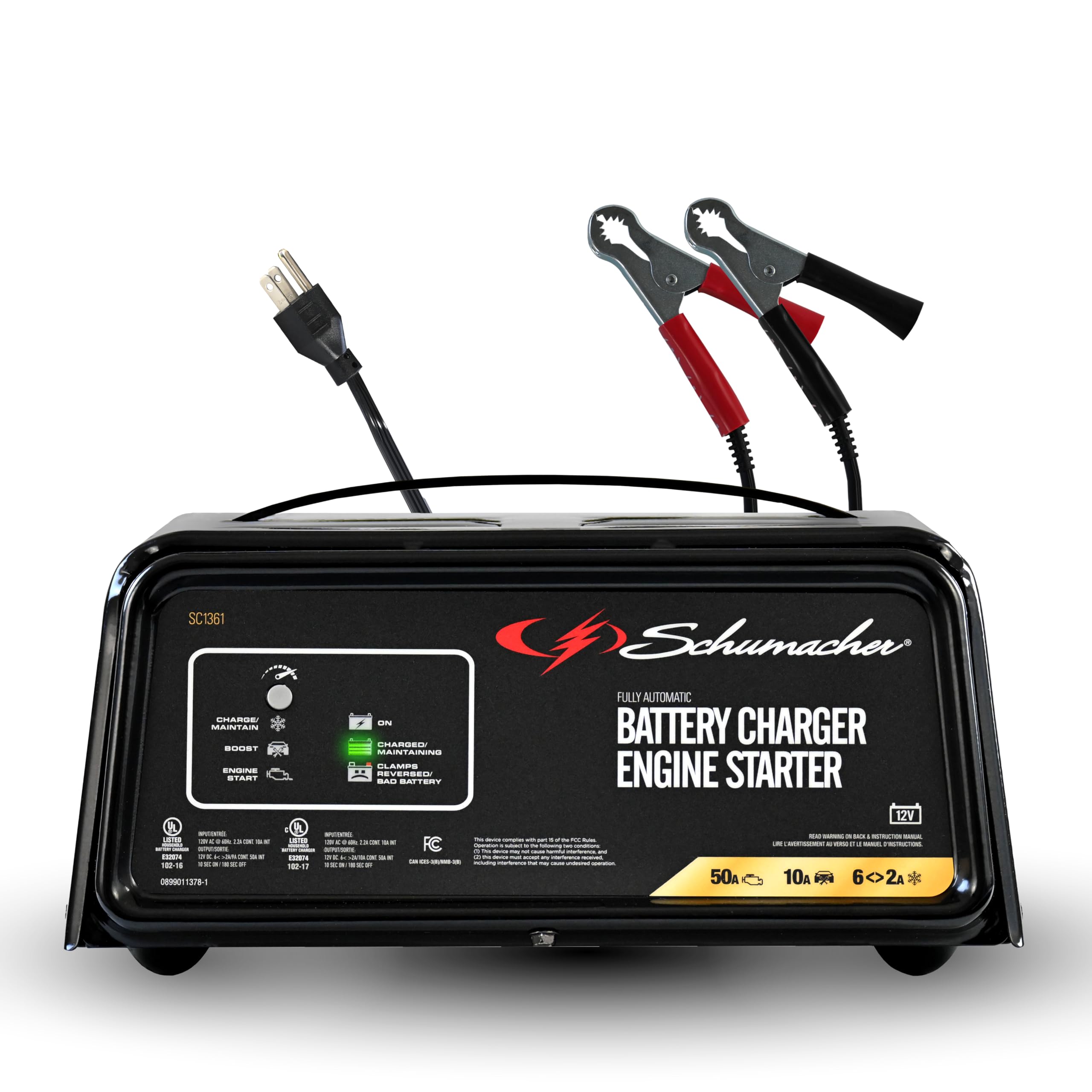
It is a solid all-in-one charger and starter for someone who wants reliable engine starts and battery maintenance without fuss.
Pros
- Starts dead batteries fast with 50A boost.
- Keeps batteries healthy with automatic multi-stage and float modes.
- Built tough with metal housing and clear controls.
Cons
- Must stay plugged in while in use; not a portable battery.
- Can be confusing at first if used to old-style analog chargers.
- Mixed performance on very deeply discharged batteries.
They kept a unit in the garage and used it on a variety of vehicles. It fired a truck with a flat battery on the first cranking and brought an ATV battery back to life after a few hours on the 10A setting. The clamps felt solid and the metal case handled repeated use without getting beat up.
They liked the smart charging because it moved from charge to maintain without needing babysitting. LED indicators and push buttons made operation simple during winter mornings. The desulfate mode showed benefit on older batteries that otherwise lost capacity.
They noticed limitations when a battery was nearly dead for a long time; the unit sometimes needed more time or a secondary charger to fully recover the cell. Users should also remember the unit requires AC power while working, so it’s best for garages, shops, or homes rather than remote use.
E-FAST 25A Charger
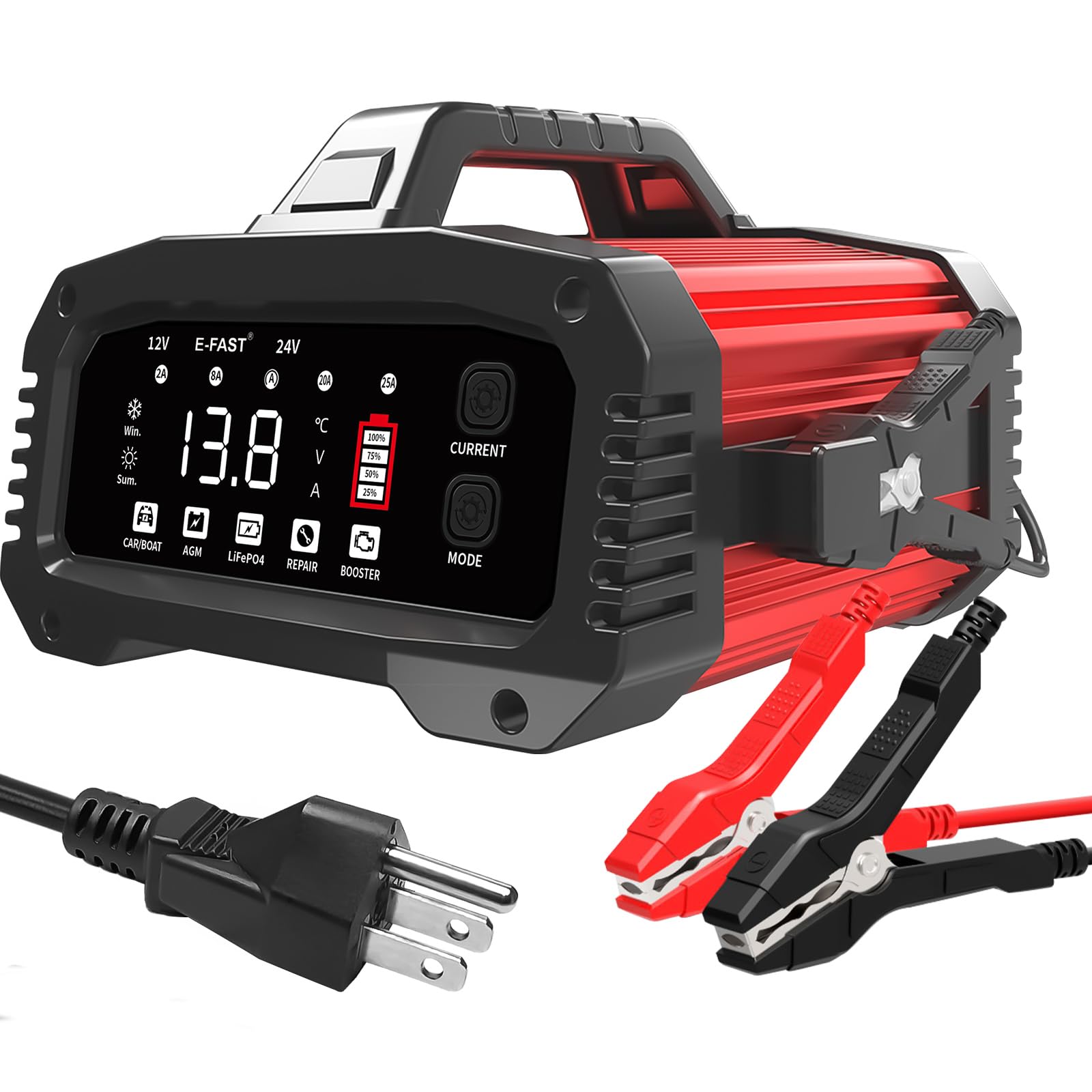
It’s worth buying for owners who need a fast, heavy-duty charger with smart modes for different battery types and emergency jump help.
Pros
- Charges large batteries quickly and works on 12V and 24V systems.
- Offers multiple manual settings plus an Auto mode for safer charging.
- Built like a tank with metal housing and active cooling.
Cons
- Mode switch can be finicky on some units and may need a replacement.
- Booster only works on 12V batteries, not 24V systems.
- Fan makes some noise during high‑amp charging.
They built this charger to move a lot of amps without getting hot. It felt solid in hand and heavier than plastic chargers, and the fan kept it steady during long charging sessions.
Using the adjustable settings helped when I moved between a bike battery and a truck battery. The Auto mode picked a safe rate most of the time, while the high 25A setting filled a truck battery far faster than a trickle charger.
The 200-second BOOSTER mode revived a nearly dead 12V battery after a short wait, which saved time on a roadside start. Just remember it won’t boost 24V packs.
Some units had a sticky mode switch in other users’ reports and one replacement was needed, so check the switch right away. Overall, it handled real-world jobs well and felt like an upgrade over basic maintainers.
PCHH BC-108 Charger

It is a strong all‑purpose charger that revives dead batteries and keeps them healthy with simple automatic controls.
Pros
- Revives very weak batteries and supports many battery types.
- Has useful modes (fast, maintain, winter) and an easy display.
- Built like a workhorse — feels solid and durable.
Cons
- Heavier than small trickle chargers, so it’s less portable.
- No ground terminal on the case for clamp grounding.
- The display and menus take a short time to learn.
They sent a unit that feels heavy and well-made. He hooked it to a long-sitting car battery and watched the nice digital readout climb over several hours until the charger automatically switched to maintain mode.
The repair mode actually brought a couple of stubborn batteries back to life that a tiny trickle charger had failed to touch. It handles 12V and 24V without fuss and the winter setting gave more confidence when charging in cold weather.
Using the clamps was straightforward, and the automatic cut-off stopped charging once the battery reached full. It did take time for deeply discharged batteries, but that slow, controlled approach helped avoid overheating and overcharge.
If portability matters, note the weight — it’s not a pocket unit. For a garage or workshop where battery repair and maintenance matter, this charger performs like a pro and saved him trips to the shop.
Buying Guide
Buyers should match charger type to their needs. Look for smart chargers that monitor voltage and adjust current automatically. These reduce overcharging risk and help long battery life.
Consider amperage next. Higher amps charge faster but can stress old batteries. Lower amps are safer for maintenance and long-term charging.
Check battery compatibility carefully. The charger must support the battery chemistry and the vehicle voltage (12V or 24V). Failure to match these can damage the battery.
Safety features matter. Seek short-circuit protection, reverse-polarity protection, and overheat detection. These features reduce accident risk and protect the vehicle.
Think about charging modes offered. Look for bulk, absorption, float, and reconditioning modes. More modes give better control for different battery conditions.
Evaluate connectors and cables for ease of use. Sturdy clamps or ring terminals and at least 6–8 foot cables make installation easier. Waterproof or weather-resistant housings help for outdoor use.
Factor in portability and mounting options. Lighter units are easier to move. Wall-mountable models save space in a garage.
Look at display and controls for clarity. Simple LED indicators or an LCD with clear icons help users monitor charging status. Intuitive menus reduce setup mistakes.
Check warranty and support. A solid warranty and accessible customer support help if defects or issues arise.
Editor’s Choice
The Editor’s Choice pick is the NOCO Genius Boost Plus GB40. It charges a dead battery fast and works with both 12V cars and small trucks. The unit is compact and easy to store in a glove box or trunk.
It features safe, automatic charging that prevents sparks and reverse polarity. The simple LED indicators make status clear, so the user sees when the battery is charged or needs service.
Key specs:
- Output: 1000A peak, 12V
- Mode: Automatic, maintenance charging
- Extras: LED flashlight, spark-proof clamps
The GB40 suits drivers who want a reliable, quick-start solution. It also helps for occasional battery maintenance. Its build quality and warranty give buyers confidence.
FAQS
What type of charger is best for a car battery?
They should choose a smart charger with automatic float and multiple charging modes. These chargers adjust current and stop overcharging.
Can a trickle charger damage a battery?
It can if left on the wrong mode. Modern trickle chargers have safety features to prevent overcharge when used correctly.
How long does charging usually take?
Charge time varies by battery size and state of charge. Small top-ups can take an hour; full charges may take several hours to a day.
Is it safe to charge a battery indoors?
Yes, if the area is well-ventilated and the charger is rated for indoor use. They should avoid open flames and sparks near the battery.
Do chargers work on all battery types?
Not always. Some chargers work only with lead-acid; others support AGM, GEL, and lithium. They must check compatibility before use.
How to maintain a battery between charges?
Use a maintenance or float mode on a smart charger. They should check connections and keep terminals clean.
What safety features matter most?
Look for reverse polarity protection, short-circuit protection, and thermal protection. These reduce risk during use.
Can charging revive a dead battery?
It may revive a deeply discharged battery if the battery isn’t physically damaged. Severely sulfated or damaged batteries often need replacement.
Conclusion
Choosing the right plug-in car battery charger helps keep a vehicle reliable and ready. They vary by charging speed, safety features, and battery type compatibility. Buyers should match a charger to their battery chemistry and daily needs.
Smart chargers add safety with automatic charging and maintenance modes. Manual chargers may work for simple, occasional use but need more attention. Higher amps charge faster, but slower charging can extend battery life.
Budget matters, but so do warranty and build quality. Look for overcharge protection, desulfation, and clear indicators. Portable design and cable length can affect ease of use.
Quick checklist:
- Match charger to battery type (lead-acid, AGM, lithium).
- Prefer smart chargers with safety features.
- Choose amperage based on charging speed and battery capacity.
- Check warranty and user reviews.
A reliable charger saves time and prevents battery damage. It gives drivers confidence that their vehicle will start when needed.