
Achieving great audio in your vehicle is easier than you think. This guide focuses on car stereo sound quality improvement through simple settings, hardware upgrades, and proper insulation. You can transform your daily commute into a high-fidelity listening experience by following these proven steps.
Do you love music? Most of us do. We spend a lot of time in our cars. We drive to work. We go on road trips. We sit in traffic. During these times, music is our best friend. But there is a problem. Most factory car audio systems do not sound very good. They can sound flat or “muddy.” You might feel like your favorite songs are missing something. If you want to fix this, you are in the right place.
This guide is all about car stereo sound quality improvement. We will show you how to make your music sound clear, deep, and loud. You do not need to be a professional mechanic. You just need some basic tools and a little bit of patience. We will cover everything from free settings to hardware upgrades. Let us get started on making your car sound like a concert hall.
Key Takeaways
- Start with the Source: High-quality audio files are the foundation of car stereo sound quality improvement.
- Dampen the Noise: Sound deadening materials reduce road noise and stop door panels from vibrating.
- Upgrade Your Speakers: Factory speakers are often made of cheap paper; aftermarket speakers provide much better clarity.
- Add an Amplifier: Clean power from an external amp prevents distortion at higher volumes.
- Use a DSP: A Digital Signal Processor lets you tune the sound specifically for your car’s unique interior.
- Check Your Wiring: Using the right gauge of wire ensures your components get the power they need to perform.
Step 1: Start with High-Quality Audio Sources
The first step in car stereo sound quality improvement does not cost a penny. It starts with what you play. If you play a low-quality file, even a million-dollar system will sound bad. This is called “garbage in, garbage out.”
Check Your Streaming Settings
Most people use apps like Spotify, Apple Music, or YouTube Music. These apps often save data by lowering the sound quality. Go into your app settings. Look for “Audio Quality” or “Streaming Quality.” Change it to “Very High” or “Lossless” if available. This makes a huge difference in clarity.
Avoid Cheap FM Transmitters
If you have an older car, you might use an FM transmitter. These are convenient, but they kill sound quality. They add hiss and static. If you can, use an auxiliary (AUX) cable or a USB connection. A direct wire is always better for car stereo sound quality improvement than a wireless radio signal.
Use High-Resolution Files
If you download music, look for FLAC or WAV files. These are “lossless” formats. They keep all the detail of the original recording. Standard MP3 files often cut out the high and low sounds to save space. When you switch to high-res files, you will hear instruments you never noticed before.
Step 2: Add Sound Deadening Materials
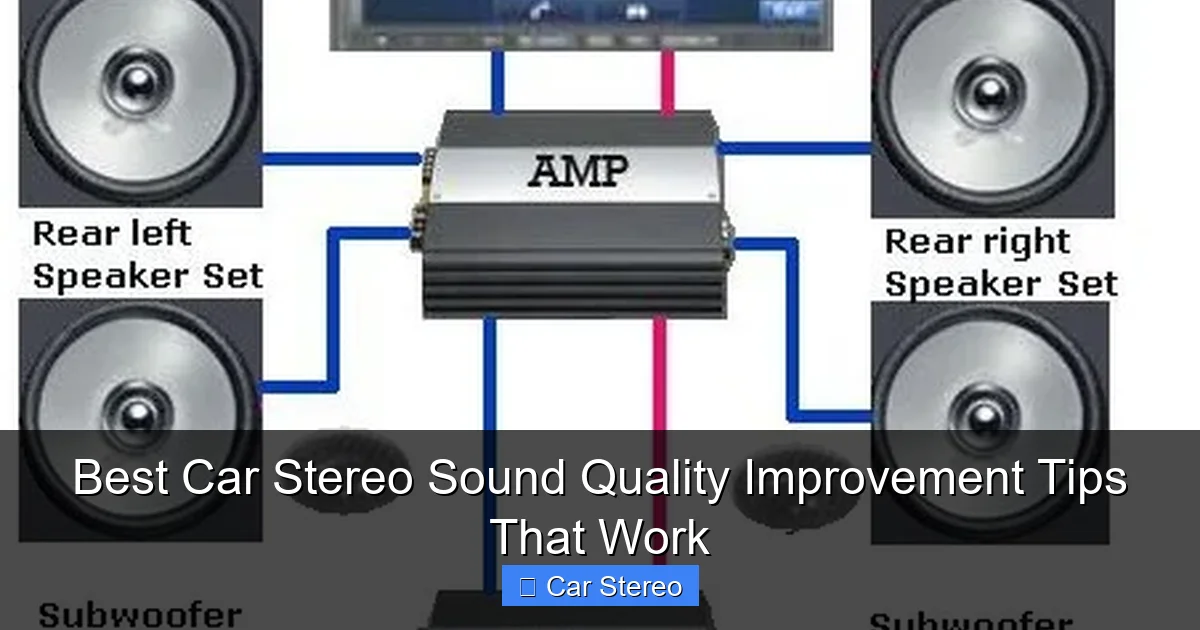
Cars are noisy. They have engine noise, wind noise, and tire noise. All of this noise fights against your music. Also, car doors are made of thin metal. When your speakers play, the metal vibrates. This makes your music sound buzzy and weak. Sound deadening is a vital part of car stereo sound quality improvement.
Visual guide about Best Car Stereo Sound Quality Improvement Tips That Work
Image source: stereoauthority.com
Apply Damping Mats to Doors
Buy some adhesive sound deadening mats. These are usually made of butyl rubber with a foil top. You stick them to the inside of your door panels. They make the metal “heavy” and solid. This stops the vibrations. When the door stops shaking, the speaker can focus on making music. It makes your bass feel much tighter.
Use Foam Gaskets for Speakers
When a speaker sits in a door, sound can leak out the sides. You want the sound to go into the cabin, not into the door cavity. Use foam rings or “fast rings” around your speakers. These create a seal between the speaker and the door panel. This is a cheap trick for instant car stereo sound quality improvement.
Cover the Floor and Trunk
If you want a truly quiet ride, add material to the floor and trunk. This blocks the road noise coming from under the car. A quieter car means you do not have to turn the volume up as high to hear the details in your music.
Step 3: Replace Your Factory Speakers
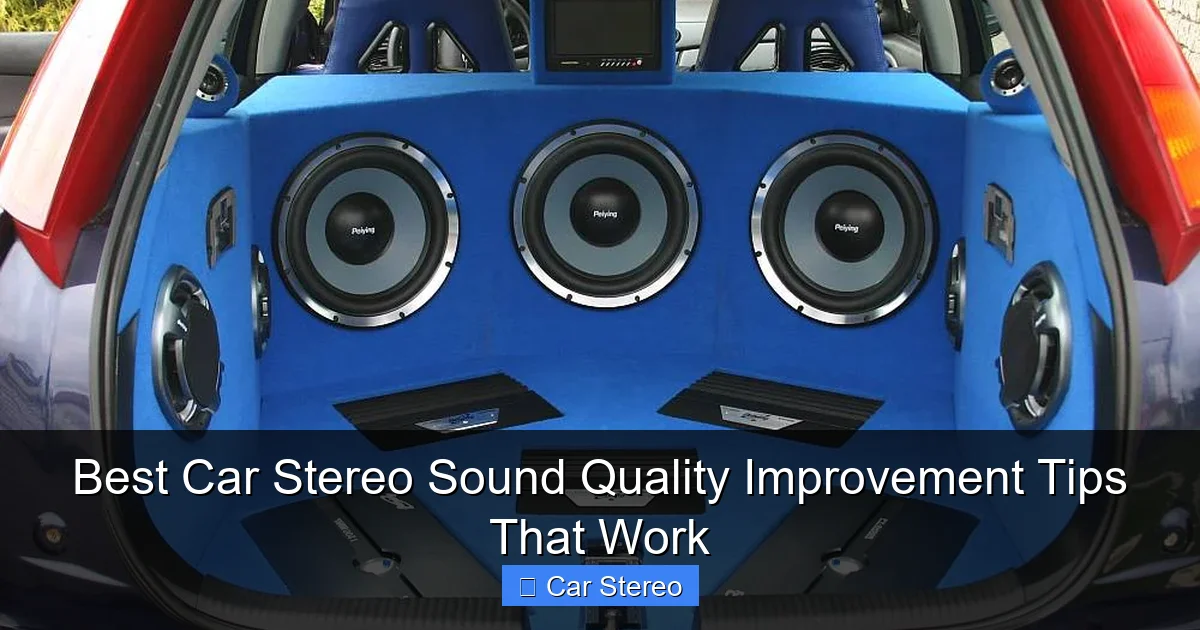
Car makers usually save money on speakers. Even in “premium” cars, the speakers are often made of cheap paper and small magnets. Replacing them is the biggest jump you can take in car stereo sound quality improvement.
Visual guide about Best Car Stereo Sound Quality Improvement Tips That Work
Image source: audiomotive.com
Choose Component Speakers for the Front
Component speakers have a separate woofer and tweeter. The woofer handles the mid-range and bass. The tweeter handles the high notes. You can mount the tweeter higher up on the dash or door. This raises the “soundstage.” It makes it feel like the singer is standing on your dashboard instead of at your feet.
Consider Coaxial Speakers for the Rear
If you are on a budget, use coaxial speakers for the back doors. These have the tweeter built into the center of the woofer. They are easier to install and work well for “rear fill.” The rear speakers should not be the star of the show. They just add depth to the room.
Match the Material to Your Taste
Different materials sound different. Silk tweeters sound smooth and warm. Metal tweeters (like aluminum or titanium) sound bright and crisp. If you like soft jazz, go for silk. If you like rock or electronic music, you might prefer metal. Choosing the right material is a personal part of car stereo sound quality improvement.
Step 4: Bypass the Built-In Amp with an External Amplifier
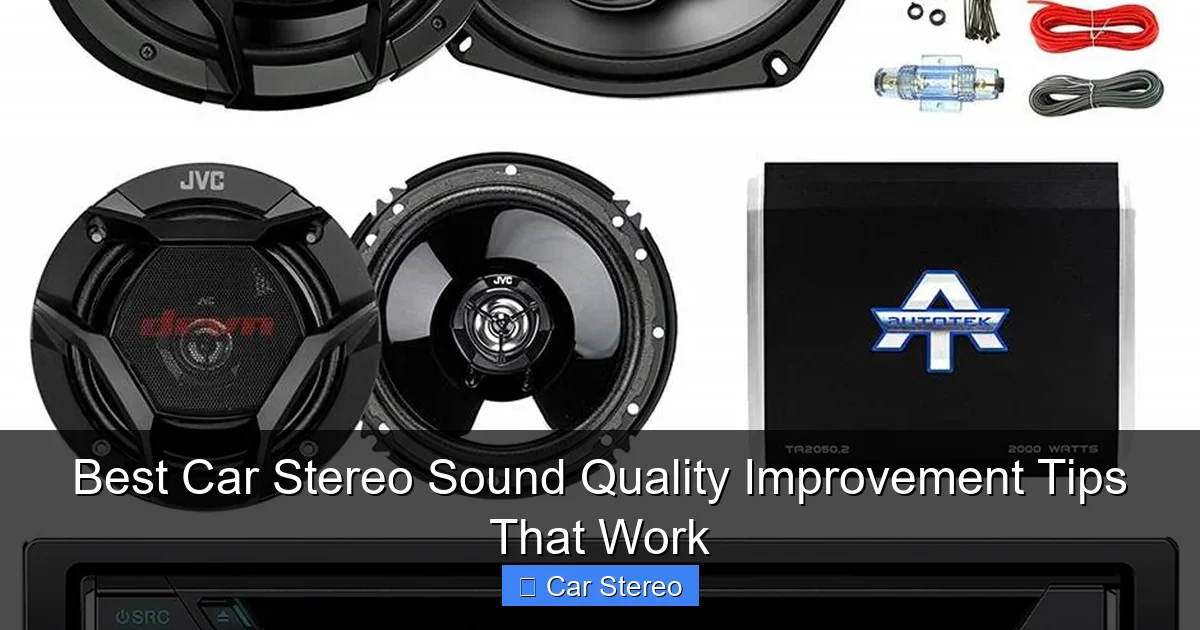
Your head unit (the radio) has a small built-in amplifier. It is usually very weak. When you turn it up, it starts to “clip.” Clipping is when the amp runs out of power and distorts the sound wave. This can actually break your speakers. An external amp is key for real car stereo sound quality improvement.
Visual guide about Best Car Stereo Sound Quality Improvement Tips That Work
Image source: bassheadspeakers.com
Get a 4-Channel Amplifier
A 4-channel amp can power all four of your door speakers. It provides “clean” power. Even at low volumes, an amp makes music sound fuller. It gives the speakers the energy they need to move accurately. This results in much better dynamics.
Understand RMS Power vs. Peak Power
When buying an amp, ignore the “Peak Power” number. This is a marketing trick. Look for the “RMS Power.” This is the power the amp can give continuously. Make sure the RMS of your amp matches or slightly exceeds the RMS rating of your speakers.
Proper Grounding is Essential
An amp needs a good electrical path. Always ground your amp to the bare metal of the car’s chassis. If the ground is bad, you will hear a whining sound that follows the engine RPM. Good wiring is the backbone of car stereo sound quality improvement.
Step 5: Add a Subwoofer for Deep Bass
Small door speakers cannot move enough air to create deep bass. If you want to feel the music, you need a subwoofer. This is a common goal for car stereo sound quality improvement seekers. A subwoofer handles the lowest frequencies that other speakers miss.
Choose the Right Box Type
There are two main types of boxes: sealed and ported. A sealed box is smaller and gives “tight” and accurate bass. It is great for rock and country. A ported box is larger and louder. It is great for hip-hop and EDM. Think about what you listen to before you choose.
Don’t Overdo the Size
You do not need two 15-inch subs to improve your sound. Often, a single 10-inch or 12-inch subwoofer is perfect. It fills in the bottom end without taking up your whole trunk. Balance is the key to car stereo sound quality improvement.
Use a Bass Knob
A remote bass knob lets you control the subwoofer from the driver’s seat. Some songs have too much bass, and some have too little. Being able to adjust it on the fly makes your listening experience much better.
Step 6: Install a Digital Signal Processor (DSP)
The interior of a car is a nightmare for sound. You sit on one side, so you are closer to the left speaker than the right. Glass reflects sound, and seats absorb it. A Digital Signal Processor (DSP) is the ultimate tool for car stereo sound quality improvement.
Correct the Time Alignment
A DSP lets you delay the sound from the speakers closest to you. By delaying the left speaker by a few milliseconds, the sound from all speakers reaches your ears at the exact same time. This creates a “center image.” It sounds like the singer is right in the middle of the car.
Use a 31-Band Equalizer
Standard radios only have “Bass” and “Treble” knobs. A DSP gives you 31 bands of control. If a certain frequency sounds harsh or “boomy” because of your car’s shape, you can turn just that one frequency down. This levels out the sound for a smooth response.
Set Crossover Points
A DSP tells each speaker which notes to play. You can stop your small door speakers from trying to play deep bass. This prevents distortion and lets them play louder and cleaner. It is a pro-level step in car stereo sound quality improvement.
Step 7: Fine-Tune Your System Settings
Once everything is installed, you need to set it up correctly. Even expensive gear sounds bad if the settings are wrong. Proper tuning is the final touch for car stereo sound quality improvement.
Set Your Gains Correctly
The “Gain” knob on an amp is not a volume knob. It matches the amp’s input to the radio’s output. If you turn it too high, you get distortion. If it is too low, you get background hiss. Use a multimeter or your ears to find the point where the sound is loud but stays crystal clear.
Keep the EQ Flat at First
Many people turn the bass and treble all the way up. This is called the “smiley face” EQ. It actually hides the mid-range where the vocals live. Start with everything flat. Only turn things up or down if something sounds wrong. True car stereo sound quality improvement is about accuracy, not just loud bass.
Check the Phase
If your bass sounds weak after installing new speakers, they might be “out of phase.” This happens if you swap the positive and negative wires on one speaker. The speakers will push and pull against each other, canceling out the sound. Double-check your wiring to ensure car stereo sound quality improvement.
Troubleshooting Common Issues
Sometimes things go wrong. Here is how to fix common problems during your car stereo sound quality improvement journey.
Engine Whine or Hiss
If you hear a high-pitched whine that gets louder when you gas the engine, it is likely a ground loop. Check your amp’s ground wire. Make sure it is on clean, unpainted metal. Also, keep your power cables away from your signal (RCA) cables.
Distortion at High Volume
If the sound gets “fuzzy” when you turn it up, you are likely pushing your amp or head unit too hard. This is “clipping.” Turn the gain down or get a more powerful amplifier. High-quality sound should stay clear at any volume.
Rattling Panels
If the bass makes your trunk or doors rattle, you need more sound deadening. Look for loose plastic clips or vibrating license plates. A small piece of foam or tape can often stop a pesky rattle.
Conclusion
Improving your car audio is a rewarding project. You don’t have to do everything at once. You can start by simply using better music files and adding some sound deadening. Later, you can add speakers, an amp, and a subwoofer. Every step you take brings you closer to car stereo sound quality improvement.
Remember, the goal is to make the music sound good to you. Everyone has different ears. Take your time, listen to your favorite tracks, and enjoy the process. Once you hear the difference a high-quality system makes, you will never want to go back to factory sound again. Happy listening!
🎥 Related Video: Best Music Output Settings for your Car😍
📺 Fuel Injected
